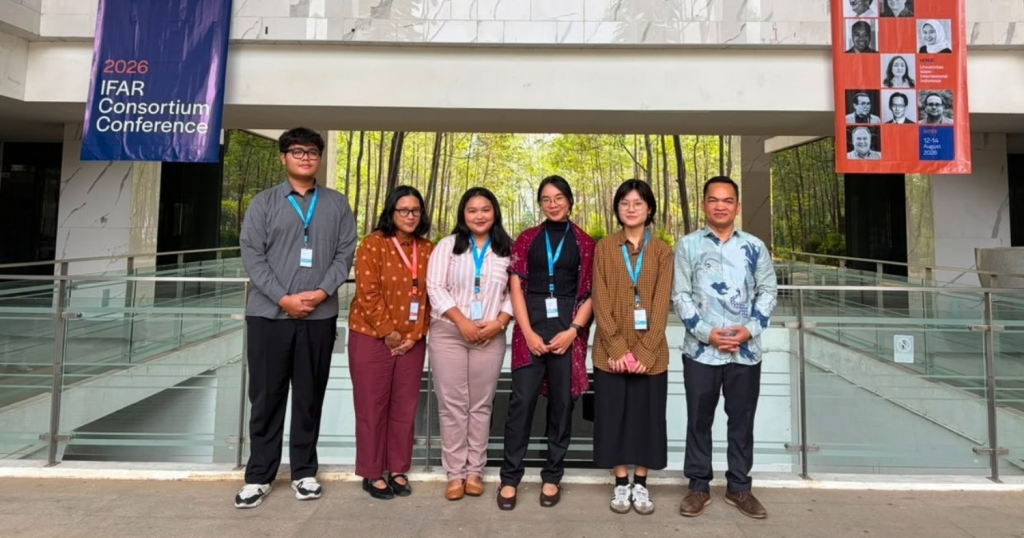
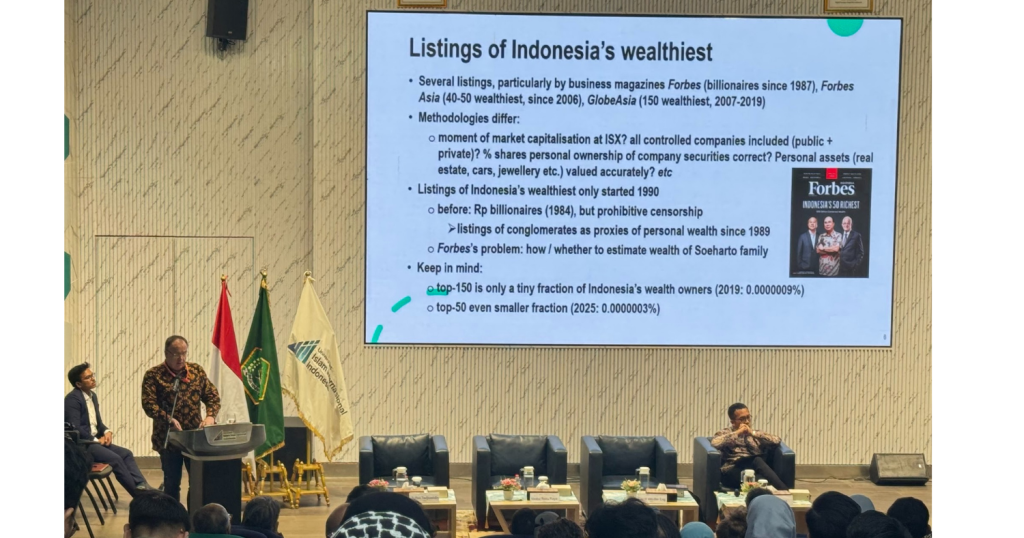
IFAR Atma Jaya attended the IFAR Consortium Conference 2026, themed “Contours of Inequality: Power, Protest, and Privilege in Southeast Asia,” held from August 12–14, 2026, at the Indonesian International Islamic University (UIII) in Depok. The conference served as a forum for academics, researchers, and practitioners to discuss various aspects of inequality in Southeast Asia.
On the first day (8/12), IFAR Atma Jaya team, supported by staff from the Atma Jaya Institute of Public Policy (AJIPP), attended and participated in the conference activities held at the Faculty A Building, UIII. The first day’s program included opening session, keynote speech, plenary session, and parallel sessions addressing inequality from political, economic, technological, gender, environmental, and other social perspectives.
As a member of the consortium, IFAR Atma Jaya also participated in a paper presentation delivered by Mirna Nadia, Research Fellow at the Institute for Advanced Research (IFAR), Atma Jaya Catholic University of Indonesia, Jakarta, during Panel E: Gender, Sexuality, and Inequality. The session was moderated by Febi R. Ramadhan from the Department of Anthropology, Universitas Indonesia. In this session, Mirna presented research titled “All for the Family: Women Heads of Household and the Heteronormative Family in Indonesia.”
This research examines how the heteronormative family as an idealized norm, shapes inequality in Indonesia. Mirna’s presentation traces the emergence and evolution of Pemberdayaan Perempuan Kepala Keluarga (Empowerment of Female Heads of Households) and explores how the organization confronts the heteronormative assumptions embedded in state practices and interventions. Within a family framework that prioritizes heteronormative structures, female heads of households often shoulder a double burden, acting as both breadwinners and household managers.
Presentation materials also indicate that female heads of households must cope with limited public support, such as access to affordable childcare services. Because their status does not fully align with dominant family classifications, they often remain less visible within population administration systems, potentially restricting their access to social assistance, legal documentation, and state protection.
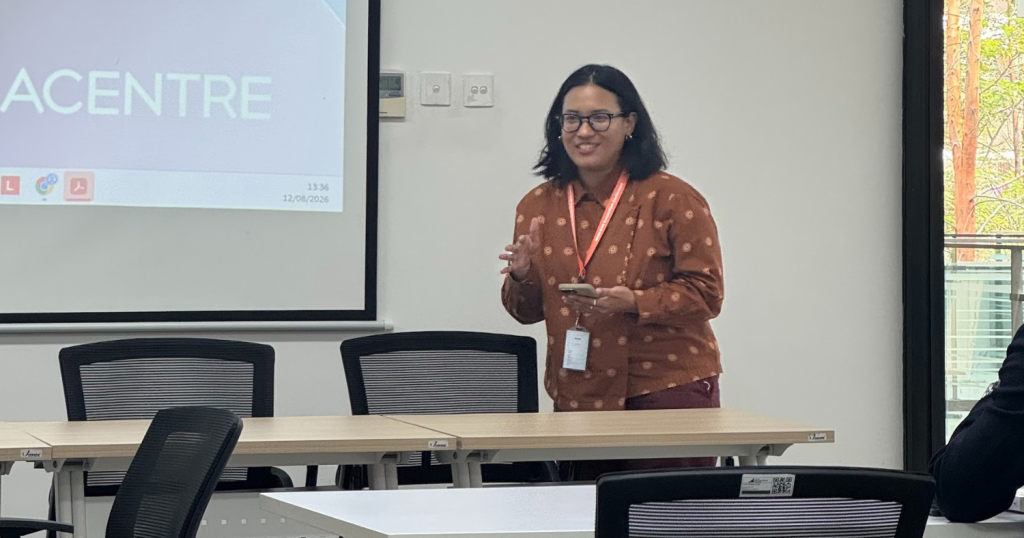
In her research, Mirna employs discourse analysis on public reports regarding PEKKA’s work from 2001 to 2024 and on media coverage. One of the study’s findings is how PEKKA reframes female heads of households as a political category. This category positions women as individuals who make significant social and economic contributions to family sustainability and as citizens possessing rights.
Mirna’s research also indicates that recognition of female heads of households is conditional. They are viewed as citizens worthy of recognition primarily when they continue to conform to the dominant image of the family, specifically, by acting as responsible women who provide for their families’ needs and fulfill caregiving roles.
In the conclusion, Mirna notes that PEKKA’s achievements extend beyond the empowerment of female heads of households. PEKKA also constructs them as political subjects and challenges the assumption that household leadership is inherently a male role. However, this process still encounters conditional recognition, as the family remains a crucial basis for securing legitimacy, recognition, and claims to rights.
The participation of the AJIPP team in the IFAR Consortium Conference 2026 is part of an effort to strengthen the institution’s engagement for knowledge exchange and academic discourse. The presentation of research on gender, family, citizenship, and public policy at this international forum highlights the importance of multidisciplinary perspectives in understanding the dynamics of inequality, specifically how it is produced, experienced, and perpetuated through institutions and social life.