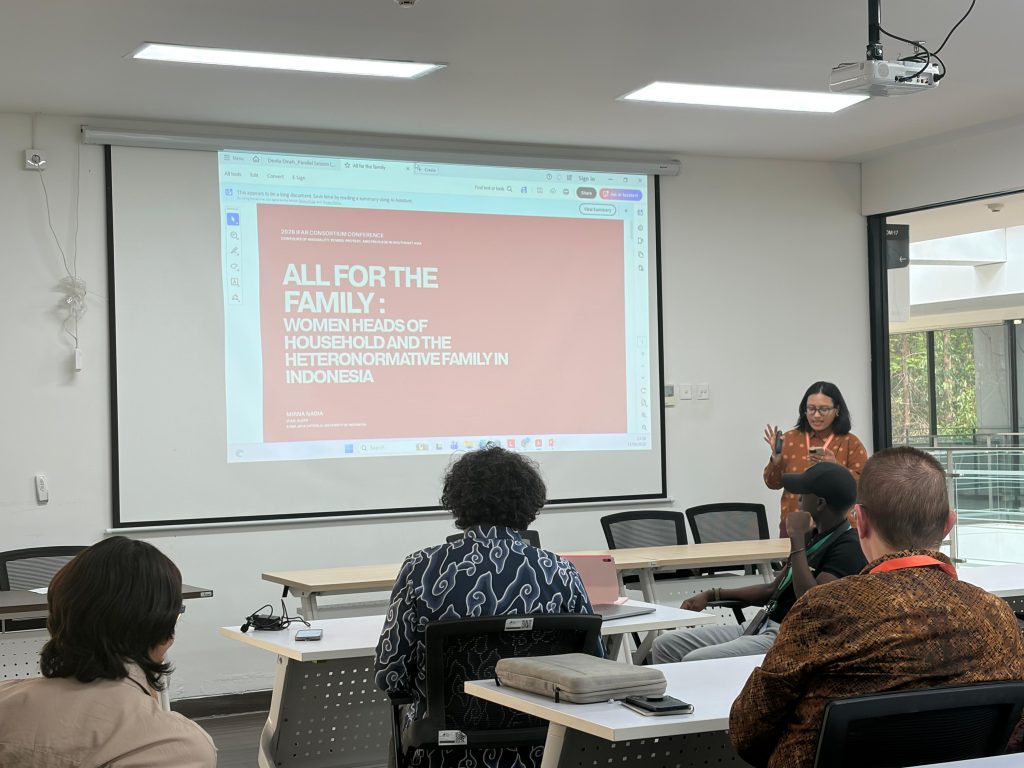
All for the Family: Women Heads of Household and the Heteronormative Family in Indonesia
Gender, Sexuality, and Inequality
All for the Family: Women Heads of Household and the Heteronormative Family in Indonesia
Mirna Nadia (Department of Sociology, Northwestern University)
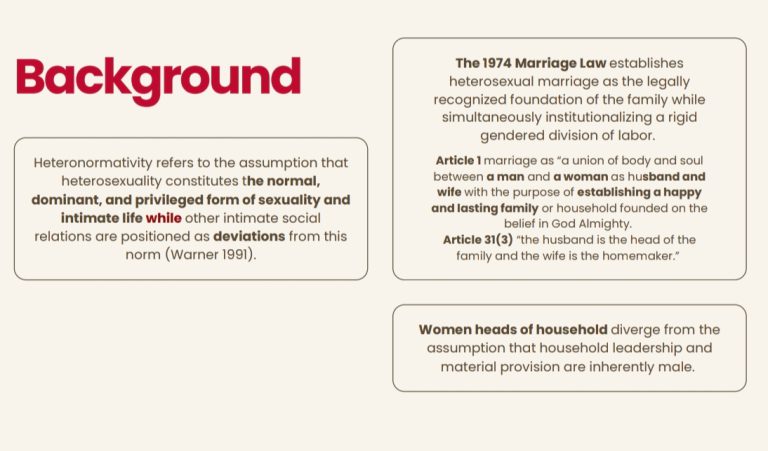
Abstract This paper examines how heteronormative family as an ideal shapes inequality in Indonesia. It traces the emergence of the Women Heads of Household Empowerment (PEKKA) initiative and analyzes how it navigates heteronormative assumptions about family embedded in state practices and policy frameworks.
Within a framework that privileges the heteronormative family arrangement, women heads of household often shoulder the double burden of being both the breadwinners and homemakers. While being the primary providers for their family, they rarely benefit from pooled household labor given men’s limited involvement in domestic work and inadequate public provisions such as affordable childcare. Women heads of household are often unaccounted for in civil registration systems and thus excluded from state benefits and legal protection. This paper argues that the recognition of women heads of household as legitimate citizens is often contingent upon their conformity to dominant narratives about family and belonging.
Drawing on discourse analysis of publicly available materials on PEKKA’s works between 2001-2024, this paper argues that PEKKA reconstitutes women heads of household as a political category grounded in women’s roles as providers and caregivers rather than marital status. The decisive shift to focus on these women’s status as providers for their families and rights-bearing citizens enabled the formation of women heads of household as a political category while also revealing the limits of recognition premised on heteronormative family ideals. Women heads of household become recognizable primarily as vulnerable subjects deserving protection and as morally-deserving, responsible providers who manage to sustain their families in the absence of a male breadwinner. Consequently, women whose lives fall outside these expectations risk being excluded, illustrating the tension within politics of recognition.
Keywords: Citizenship, inequality, gender, redistribution, women heads of household
This working paper is presented at the 2026 IFAR Consortium Conference | Contours of Inequality: Power, Protest, and Privilege in Southeast Asia August 12-14, 2026 UIII, Depok, Indonesia